Built to Last & Fully Tailored: Top-tier garbage, sweeper and sewer trucks crafted for unrivaled durability. A trusted choice for municipal governments across the globe.
How the Hydraulic Brain Controls a Self Tipping Garbage Truck
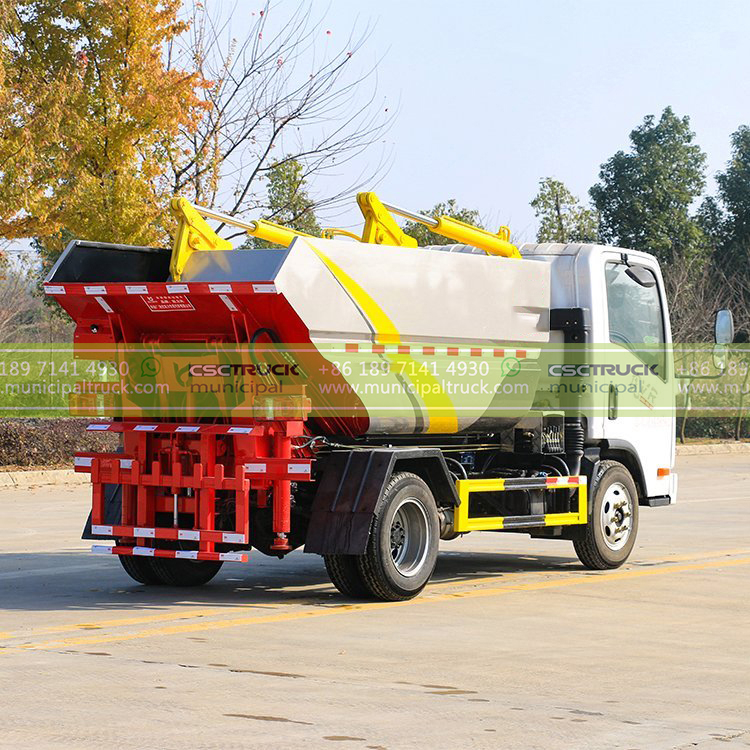
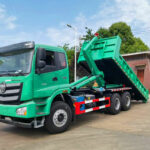
When an operator presses the “Unload” button on a self-tipping garbage truck, the action looks simple: the body lifts, waste slides out, and the truck returns to position.
But behind that 40–50 second cycle is a coordinated hydraulic control system — often referred to as the “hydraulic brain.” This system ensures that unloading happens safely, efficiently, and only under the right conditions.
At first glance, a self-tipping garbage truck appears to operate purely on brute force. As the hydraulic cylinders extend, the truck body tilts, and gravity seems to handle the rest. In reality, this apparent simplicity conceals a highly engineered control system. The hydraulic tipping mechanism continuously evaluates stability, load distribution, discharge completion, and surrounding conditions before and during every dump cycle. Before lifting begins, the system confirms the vehicle is stationary and properly secured. As the body rises, sensors monitor tilt angle and hydraulic pressure to ensure the load remains balanced and within safe limits. At full extension, the system determines whether the waste has fully discharged and checks for obstacles above or behind. Delivering this level of precision requires seamless coordination between the hydraulic system, electronic control units (ECUs), pressure and angle sensors, and multiple safety interlocks — all working together in real time to guarantee safe and efficient unloading.
The Hydraulic Foundation
The tipping process begins with the power take-off, a device that draws energy from the truck’s engine and transfers it to a hydraulic pump. This pump generates pressurized fluid, and then directed to the lifting cylinders. Unlike many hydraulic applications that operate intermittently, a self-tipper’s hydraulics endure intense, repetitive cycles. Each lift involves rapid pressure build-up, sustained high pressure during the hold, and decompression during lowering, placing immense stress on every component.
Self-tipping garbage trucks almost universally employ double-acting telescopic cylinders—multi-stage designs that achieve high lift heights from a compact package. These cylinders must generate sufficient force to lift containers weighing several tons, extend smoothly without sudden movement, retract reliably under load, and withstand side-loading forces from uneven terrain. The bore diameter determines force output, while the number of stages impacts stability.
A significant advancement in tipping technology came with the development of self-contained auxiliary hydraulic systems. These systems include their own hydraulic fluid reservoir, pump, motor assembly, and control manifold, requiring only an electrical connection to the vehicle’s battery. This innovation allows the vehicle engine to run at normal idle during tipping operations, delivering significant fuel savings compared to systems requiring elevated idle speeds while reducing noise during collection.
The Control Logic
Modern self-tipping systems follow a logical sequence that begins before the first movement. The system first verifies that the vehicle is stationary, the parking brakes are engaged, the support legs are deployed, and the ground is stable. Only when all conditions are satisfied does the lift begin.
As the body rises, angle sensors track tilt while pressure sensors monitor load, with the system automatically adjusting flow to ensure smooth motion. When the waste begins sliding out, the system may pause at maximum angle to guarantee complete emptying. Finally, the cylinders retract under power, returning the body to transport position.
Modern self-tippers increasingly leverage electronic control units that offer transformative benefits. These units can execute complex, optimized lift and lower curves—fast initial lift-off to minimize time, gentle deceleration near the apex to prevent shock, a brief hold for complete emptying, controlled initial descent, and faster lowering once clear of the hopper. This programming maximizes speed while enhancing stability and safety, representing the constant engineering tension between productivity and control.
Many high-end garbage trucks use programmable logic controllers with integrated control systems. These controllers ensure that operations occur in the correct order while maintaining interlocks between operating instructions. The PLC approach offers reduced external wiring, lower failure rates compared to relay-based systems, and the ability to implement complex safety sequences integrated with diagnostic systems.
Safety Intelligence
The most dangerous moment for a self-tipping garbage truck is during the dump. To prevent tip-overs, many vehicles are equipped with hydraulic support legs that deploy before lifting begins. These legs extend the vehicle’s stability footprint, transfer load directly to the ground, and compensate for uneven surfaces. Some systems include interlocks that prevent tipping unless the support legs are fully deployed.
The tipping angle is carefully calculated to allow waste to slide out completely—typically 45 degrees or more. Angle sensors provide real-time tilt data, and if the vehicle exceeds safe operating parameters, the system may sound an alarm, automatically stop the lift, or slowly lower the body.
Advanced systems monitor hydraulic pressure to infer load weight, enabling adaptive motion control that adjusts flow for consistent speed whether the container is empty or full. If pressure exceeds safe limits, the lift may be inhibited. Additionally, each container’s weight can be recorded for billing or route optimization.
Multiple layers of safety protection are standard, including emergency stop buttons at both the cab and rear operating positions, interlocks that prevent simultaneous conflicting operations, hydraulic lock valves that prevent uncontrolled descent in case of hose failure, and visual and audible alarms during tipping.
The Evolution to Smart Systems
The control of self-tipping mechanisms has evolved dramatically. Early systems used direct hydraulic valves operated by levers, with operator skill determining smoothness and no safety interlocks beyond mechanical stops. The electro-hydraulic era brought solenoid valves controlled by switches, basic safety logic via relays, and the possibility of remote operation. Today’s PLC-based systems offer full logic control, programmable sequences, integrated diagnostics, and data logging capability. The emerging generation of smart adaptive systems adds load sensing, real-time optimization, predictive maintenance alerts, and fleet management integration.
The hydraulic brain constantly works to minimize cycle time while maintaining safety. Loading cycles typically complete in 35 seconds or less, while dump and unloading times target 50 seconds or less. These times represent a carefully engineered balance between speed and control.
Modern systems increasingly integrate with fleet management platforms. Weigh-as-you-lift systems record each container’s weight and associate it with GPS coordinates. Wireless interfaces upload transaction data in real-time. Predictive maintenance algorithms monitor hydraulic health and alert operators before failures occur. Some advanced systems achieve cycle times of just five to eight seconds for cart tipping operations while simultaneously recording weight data.
Self-tipping systems offer multiple control methods to suit different environments. Cab-mounted levers provide simple, reliable control for daily operations. Rear-mounted panels allow operators to observe dumping directly at complex sites. Wireless remotes offer maximum flexibility and best visibility for tight spaces or hazardous areas. PLC touchscreens deliver programmable sequences and diagnostic feedback for high-end fleets.
The hydraulic brain communicates with operators through visual indicators showing system status, alarms warning of unsafe conditions, position indicators confirming completion, and diagnostic displays providing fault codes. In case of electronic failure, most systems retain manual backup capabilities, ensuring that trucks can still complete their routes and return to the depot for repairs.
Beyond Self-Tippers: The Hydraulic Brain Across Sanitation Fleets
The “hydraulic brain” technology that governs self-tipping garbage trucks is far from unique to waste collection—it forms the foundational intelligence across an entire family of specialized vehicles. In compactor garbage trucks, the same hydraulic intelligence orchestrates the complex dance of loading hoppers, advancing compaction blades, and ejecting dense waste blocks, with PLC controllers ensuring that compression cycles occur safely and efficiently without operator error. Vacuum sewer trucks rely on this hydraulic intelligence to manage the delicate balance between powerful suction and precise discharge, using load sensors and CAN bus systems to prevent overfilling and protect expensive vacuum pumps from damage. The sophisticated hydraulic systems, guided by electronic intelligence, transform raw power into precise, safe, and efficient work—making modern sanitation and recovery vehicles far more than simple trucks, but rather mobile platforms of engineered intelligence.
Conclusion
The self-tipping garbage truck‘s “hydraulic brain” is not a single component but a distributed intelligence spanning hydraulics, electronics, and software. From the independent hydraulic system that requires only a battery connection to the PLC controllers that sequence every operation, this intelligence ensures that thousands of lifts per week occur safely, efficiently, and reliably.
When you see a garbage truck empty a bin in seconds, remember that simple act represents decades of engineering evolution—pressure sensors calculating weight, angle sensors monitoring stability, control valves modulating flow, and safety systems standing guard. The hydraulic brain never rests, ensuring that every dump is precisely the right dump.